Unified Geospatial Data for Planning, Development & Site Evaluation

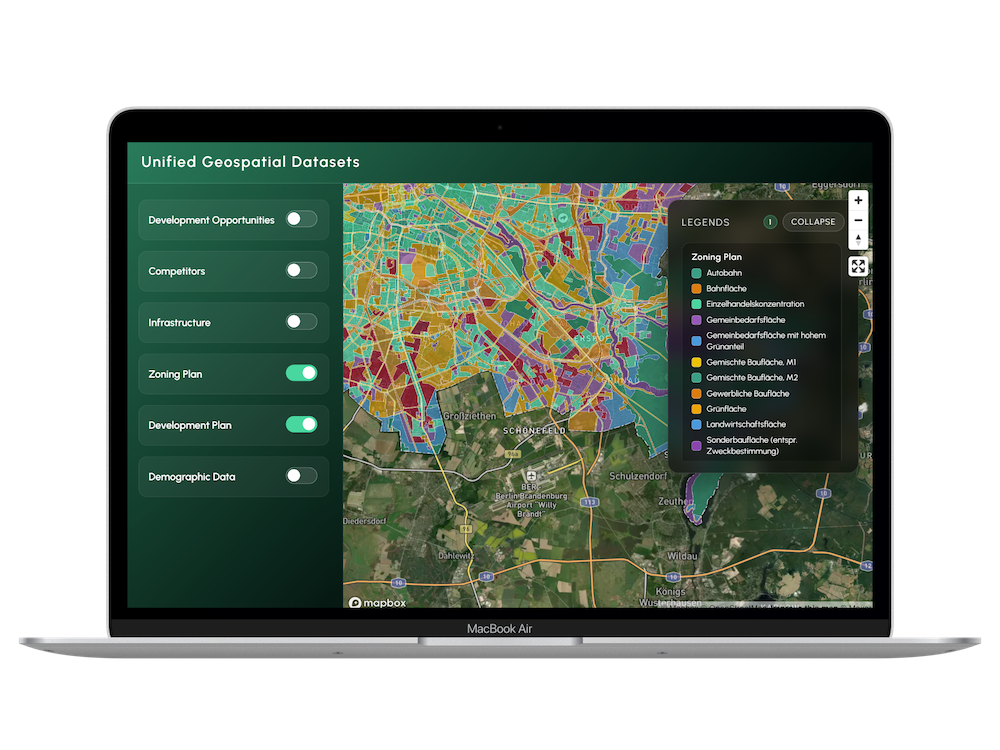
We unify planning, zoning, infrastructure and demographic data from all 16 federal states into one model for faster, consistent analysis - usable in GIS or our explorer tool.

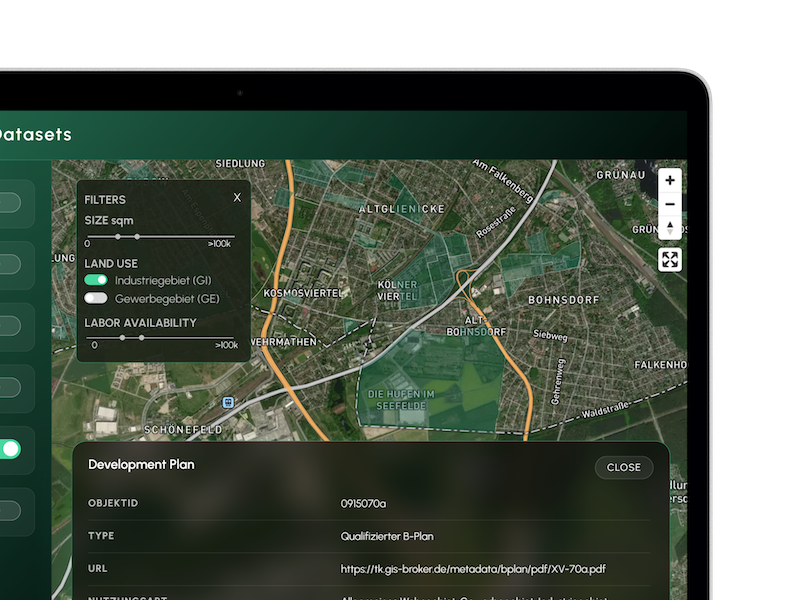
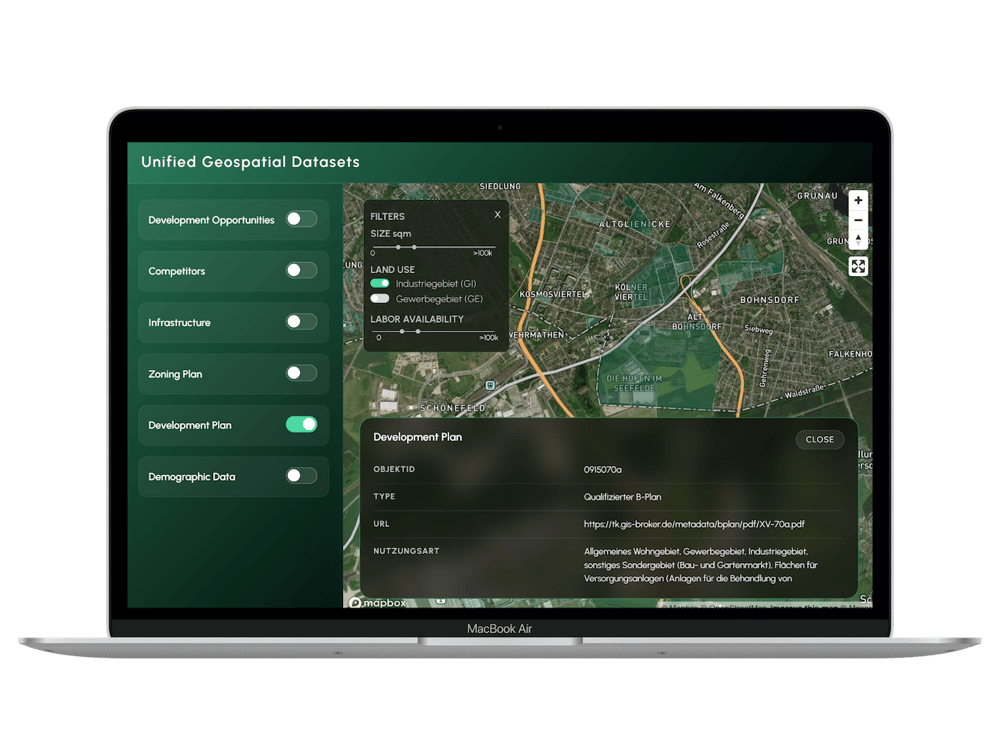
b-plan description + filter-1

Every planning or development workflow faces the same data challenges.

⛔︎ Fragmented Public Data Source

Planning, zoning and land-use information is published differently across states and municipalities, making cross-regional analysis difficult.

⛔︎ Manual Research Workflows

Finding B-Plans, FNPs, or parcel-level information frequently requires hours of manual searching through multiple sources. 

⛔︎ Delayed Access to New Opportunities

Limited digitization and missing datasets mean new development plans are often discovered too late.

Mapular provides a unified dataset built from public planning, zoning, infrastructure and demographic data.

Mapular brings together datasets from across Germany and presents them in one harmonised structure. Where states publish digital GIS layers, these are integrated directly. Where only documents or portals are available, we link and structure those sources for consistent exploration.

Weekly updates for latest publicly available information.

For GIS workflow use or instant analysis in our map-based explorer tool.

zoning layer-1

What used to take days of research can now be done in seconds where digital data is available.

Unified zoning view

See zoning classifications consistently wherever GE, GI or other zoning attributes are published.

Planning Updates

Track where new B-Plans, FNPs or municipal planning updates have been released.

Land-use & zoning

Understand how high-level land use (FNP) aligns with detailed zoning (B-Plan) across municipalities.

Mapular Standortanalyse Industrie & Logistik-1

Capabilities (Filter / Layers)

Land-Use (Flächennutzungsplan)
- Gewerbliche Baufläche (G)
- Other FNP classes where available 

Zoning / Development (B-Plan)
- Gewerbegebiet (GE)
- Industriegebiet (GI)
- Additional B-Plan zones where published digitally

Motorway Proximity
- Identify areas with strong transport accessibility. 

Labor Availability
- Assess population and employment indicators to understand regional labour context. 

Parcels
- Filter parcels by size where parcel polygons are part of digitised B-Plan datasets.

Data Availability

Unified coverage across all 16 German federal states: Mapular aggregates planning, zoning, infrastructure and demographic datasets from every federal state. Because each state publishes data differently, coverage ranges from fully digitised GIS layers to partial coverage or document-based sources. All datasets are presented in one unified structure. Coverage expands continuously as new digital datasets and services are released by states and municipalities.

Digital Planning & Zoning

Fully digitised FNP and zoning datasets, ready for spatial analysis. All data is provided in a unified structure and can be fully filtered, queried and visualised within the explorer tool / accessed in the data set.

  • Baden-Württemberg
  • Brandenburg
  • Berlin
  • Nordrhein-Westfalen
  • Rheinland-Pfalz
  • Sachsen
  • Schleswig-Holstein
  • Thüringen

Partial Digital Coverage

Planning and zoning information is partially available in digital form. All digital components are integrated into the explorer tool / data set; any missing areas are complemented with transparent links to official portals.

  • Bayern
  • Hessen
  • Niedersachsen
  • Saarland
  • Mecklenburg-Vorpommern
  • Hamburg
  • Bremen

Document-based / Portal-only

Planning information is only available as documents or through municipal portals. The explorer tool / data set provides direct access to these official sources, keeping all research centralised and easy to navigate.

  • Sachsen-Anhalt

Mapular gives you two ways to work with the harmonised data set.

Unified Geospatial Dataset

Ready data set to integrate directly into GIS, CAD, BI.

Mapular Explorer

An instant planning and mapping interface - No GIS setup required. 


Built to support multiple planning and analysis workflows.

Infrastructure & Utilities Planning

Align infrastructure investments with planning and zoning realities.

Consulting & Advisory

Accelerate feasibility studies, market assessments and location reports.

Real Estate Development & Site Evaluation

Compare zoning, land-use and demographic context across municipalities.

Industrial & Logistics Site Scouting

Identify GE/GI zones, evaluate transport access and assess workforce availability.

Retail Network Planning

Locate suitable expansion areas by combining planning context, demographics and accessibility.

Public Sector & Economic Development

Identify spatial opportunities, development corridors and long-term planning trends.

Geospatial Modelling & Analytics

Use harmonised multi-state data as structured inputs for analytical models.

The Impact of Unified Geospatial Data.

Frequently Asked Questions

Do you modify or correct the original planning data?

No. We aggregate and present public datasets exactly as published. We apply a unified schema for consistency, but do not alter underlying content.

Why does availability differ by state?

Each state publishes planning data differently. Some offer GIS layers, others documents or portals. We include all publicly available sources.

Can I export the data into my own systems?

Yes. All data can be exported and integrated into your systems.

How often do you update the datasets?

Weekly, aligned with newly published planning or zoning data.

Is the Mapular Explorer Tool required?

No. It’s included for convenience, but the core product is the harmonised dataset.

How can I get access to the unified geospatial data set?

Explore the unified geospatial data and how you can use it. Schedule a call with our team!

Unified schema

Standardized format across states. 

Source transparency

Each layer links back to its official dataset.

Continuously updated

Coverage improves as new GIS layers becomes available.

Logo-1

We help companies make better location decisions by unifying spatial data into accessible, actionable insights. Our team combines backgrounds in GIS, data engineering, and analytics - building tools that turn data into real business value.